
The Climate Control Floors Technical FAQ
-
Wet UFH systems are typically 25% to 40% more efficient than traditional radiators. This is due to the "Radiant Heat" principle. While radiators rely on convection (heating air that rises and leaves cold spots), UFH turns the entire floor into a low-temperature heat emitter. This allows the system to reach the same comfort levels with a water flow temperature of 35°C–45°C, compared to the 65°C–80°C required by radiators.
-
Absolutely. We perform Heat Loss Calculations to ensure the system is sized correctly. In modern, well-insulated homes (built to Part L regulations), UFH can easily replace radiators entirely, even in rooms with large windows or high ceilings.
-
Yes, it is the perfect partner. Air Source and Ground Source Heat Pumps are most efficient when producing low-grade heat. Because our UFH systems have a massive surface area, they can heat your home perfectly using the lower temperatures provided by a heat pump, maximizing your Coefficient of Performance (CoP) and lowering energy bills.
-
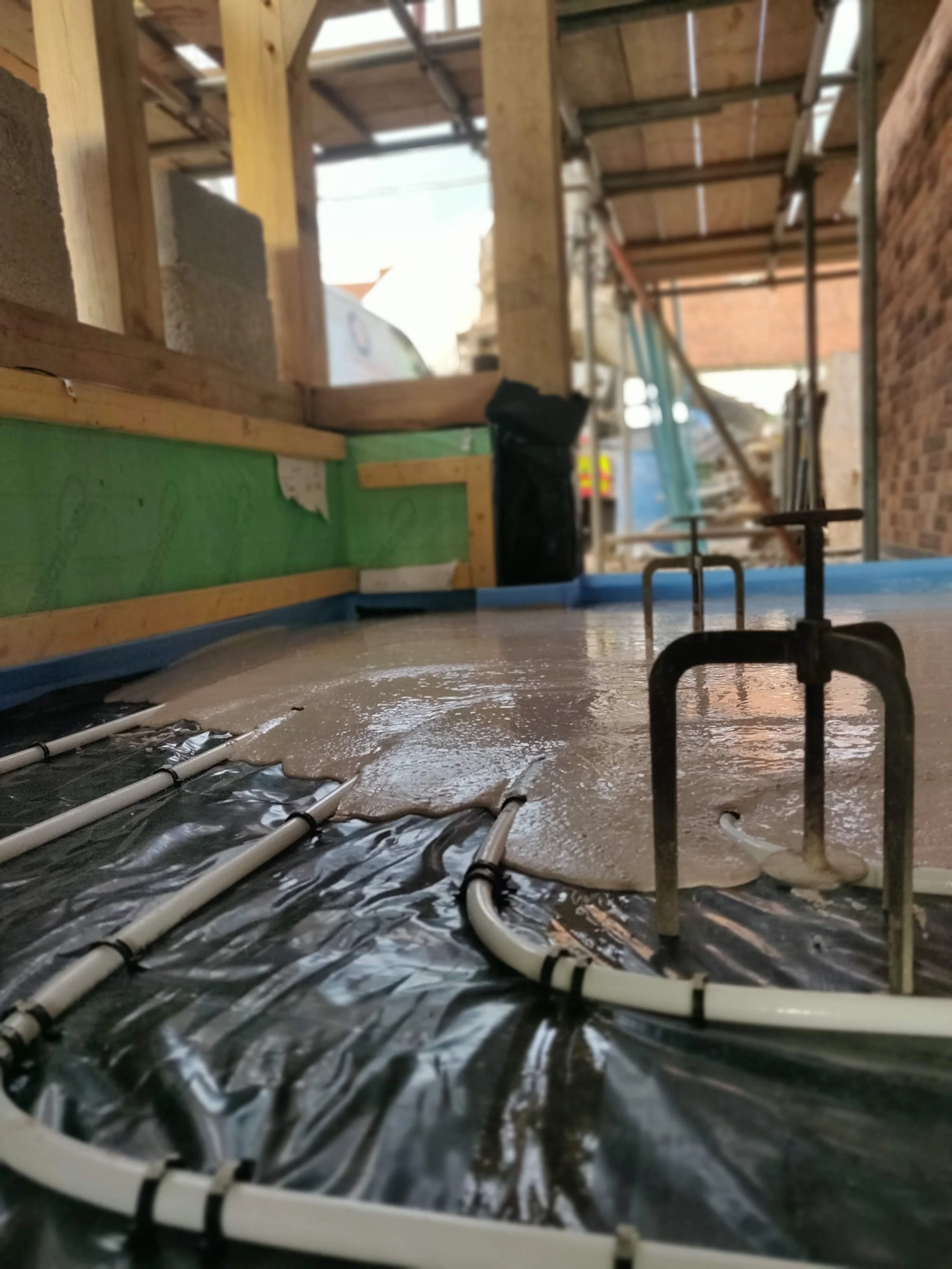
Technical performance is the main reason. Liquid (flowing) screed has a higher thermal conductivity (typically 2.2W/mK) compared to traditional screed (~1.1W/mK). Because it is poured as a liquid, it completely encapsulates the heating pipes, eliminating the air pockets that act as insulation in dry mixes. This results in a 30% faster response time and more even heat distribution.
-
While a bonded specialist Screed without UFH can be as low as 12mm, for a standard wet system, we typically recommend a minimum of 35mm cover over the pipes (ideally a 50mm average). This is significantly thinner than the 65mm–75mm required for traditional sand and cement, which helps keep floor build-up heights low—critical for renovation projects. Low profile UFH systems with specialist Screeds can go as low as 17mm.
-
You can usually walk on liquid screed within 24–48 hours. However, the heating must not be turned on immediately. We recommend a "curing" period of at least 7 days, followed by a gradual "commissioning" process where the temperature is increased by 5°C per day to prevent thermal shock and cracking. A drying and commissioning technical pack will be provided with all installations
-
We use high-grade PERT or PEX-a pipe with no joints hidden beneath the floor surface (all connections happen at the manifold). Every system is pressure-tested to 6 bar for 24 hours before the screed is poured. Once encased in screed, the pipes are protected from oxygen and physical damage, giving them a design life of 50+ years.
-
For existing concrete slabs/Screeds we offer Low-Profile Retrofit Systems (such as overfloor panels) that add as little as 17mm to your floor height. This allows you to install UFH without the need to dig up existing concrete slabs or adjust door frames significantly. For floating timber floors we offer a joist system under the floorboards adding no extra floor height.
-
To ensure efficient heat transfer, the combined rating of your carpet and underlay should not exceed 2.5 Tog. For maximum efficiency, we recommend ceramic tiles, stone, or polished concrete, as these have the lowest thermal resistance.
-
Yes, this is called Zoning. One of the biggest advantages of UFH is that you don't have to heat the whole house at once. Each room has its own thermostat, allowing you to keep bedrooms cooler and living areas warmer, significantly reducing wasted energy.
-
The pipework itself is maintenance-free. However, we recommend a brief annual check of the manifold components, pump, and mixing valve to ensure the mechanical parts are moving freely and the system pressure is stable.